Arlington, AZ |
||||||||
| Home | Geography | Prehistory | Early History | History | Today | Bibliography | ||
| History: 1890 to 1990 - Commerce | |
Settlement Pioneers Agriculture Commerce Transportation Schools Cemeteries |
Trade Stewart Chapin, a native of New York, built a store for the community and then returned to New York. The store was utilized for years as the post office and whoever owned the store was typically the postmaster. Moses Clanton is listed as the first postmaster. Local farmers Clanton and Millett built a building to serve as a hotel near the highway to server travelers on the Phoenix-Yuma highway. To the east of the hotel, on the same property, was a grocery store. Claude Ritter ran the store initially, then sold it to C. W. Peterson who eventually sold the property, with the hotel, to Jack and Ethel Gable. The store was moved from its location to the other side of Arlington Mesa and utilized as a pool hall until it was destroyed in a fire. (Murphy, 3-5) |
 |
|
|
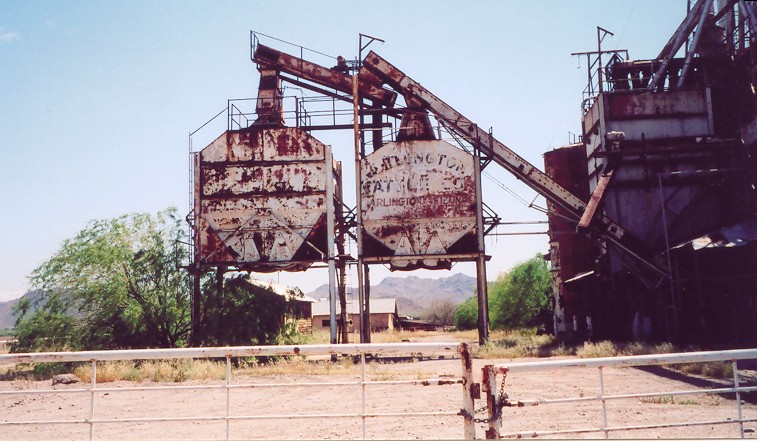
Ranching The Arlington Cattle Company Theron Hill was in the Arlington Valley in 1900. He bought up ranch property in the area starting what became known as the Hill Ranch. This ranch was incorporated in 1910 as the Arlington Improvement Company with owners, Dwight B. Heard, K. S. Townsend (founder of Good Samaritan Hospital), George and James Day, and S. C. Mason after James Day purchased Hill's stock. |
 [Click to Enlarge] |
||
|
In 1936, the Arlington Improvement Company stock was transferred to the
Dwight B. Heard
Investment Company, which also built the
Hotel San Carlos in downtown Phoenix. Laurids Anderson, who had been foreman purchased the ranch from
Heard that same year and sold it in 1947.
The Arlington Cattle Company changed hands over the next couple of decades until it was purchased by William La Follette, Charles Sherill, and Louis Wingfield . La Follette was killed in a helicopter accident in 1983 and the company went into receivership, a portion of the property is currently owned by the State of Arizona. The remainder, has laid unused for two decades, its vast array of stockpens rusting in the Arizona sun. (Murphy, 74, 85-86; Gable; Civil Deed 83-0192334, ASG F/S 84-0219373, Court Order 90-0373602 ) |
|||
Farming Alfalfa seed was a cash crop as was wheat, barley, and milo maize. But Alfalfa was great. As recorded by a nineteenth century farmer, "with an abundance of water there is almost no end for what can be attained from a field of alfalfa." Once a crop reaches maturity, if it is cut completely down, it will return again with the removal of the old stock. One could get two good cuttings in July and September respectively and some farmers sent their children to college on their alfalfa profits alone. ( Cultivator & Country Gentleman, 57:224; Gable; ANPRH, 6:5) |
|||